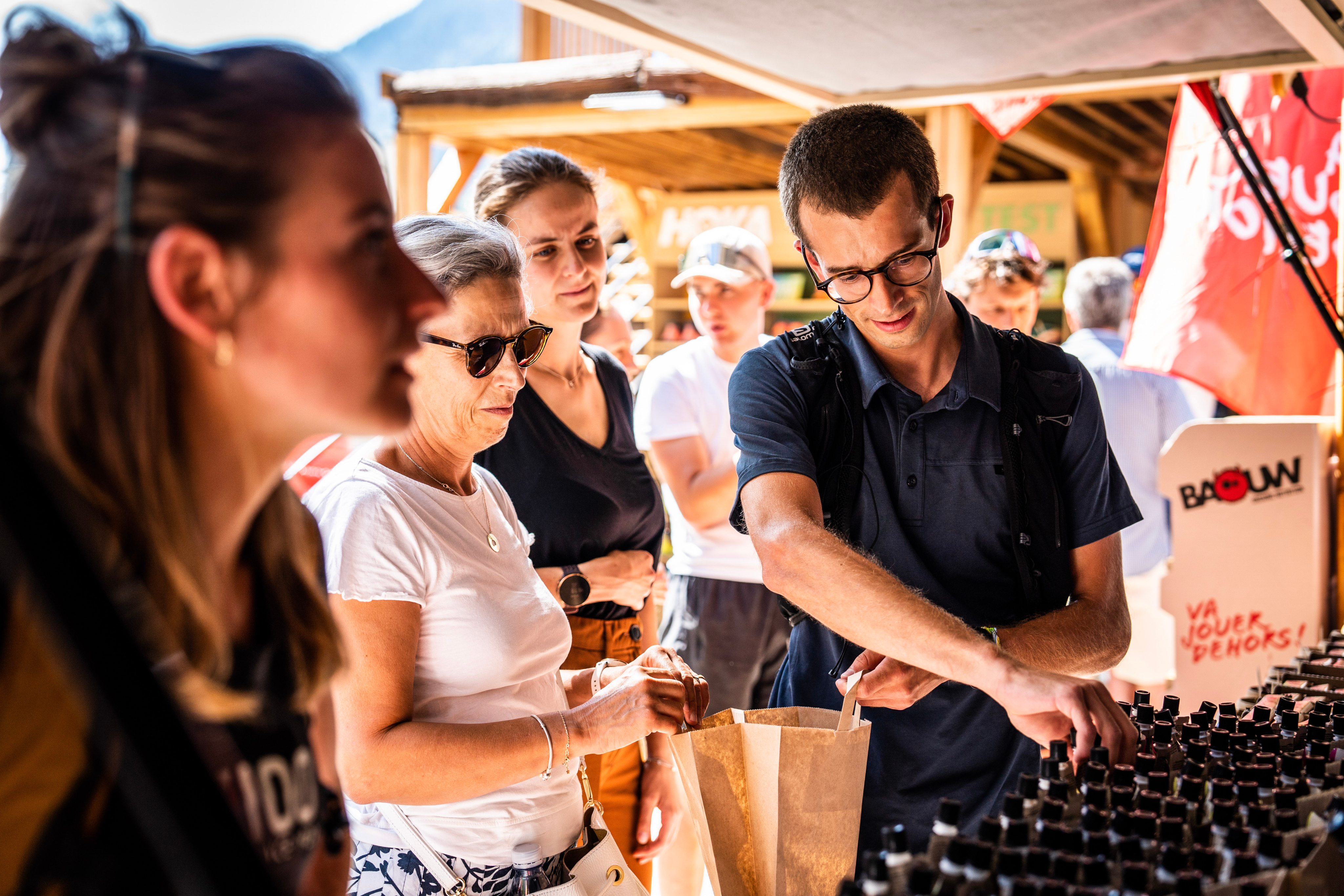

Now one of the best and most popular runners on the planet, and one of those who make you want to try out the sport, the young man from La Roche-sur-Foron in Haute-Savoie is first and foremost a great professional. A pure product of the mountains and a true professional who has turned his passion into a profession. An opportunity? No, a project and a daily investment! His recipe? To have: a good fork when it comes to training; a knife between his teeth before each race; and to never use the back of the spoon, i.e. to take risks and move forward, whatever the dish of the day. So let's sit down with our new Baouwer, a professional epicurean who has become a self-taught nutrition expert through his hunger to share and his thirst for discovery.
FAMILY, BEETROOT & RECIPES
Thibaut, how do you feel about joining the Baouwers family?
I'm delighted. I like being part of a team made up of athletes from different disciplines. Each of us is involved in a specific sport with a view to performance, but at the end of the day, we're all involved in a range of activities, for pleasure or for training. We also all share the same values and this playground that is nature. The exchange of experience on preparation, the approach to competition and nutrition promises to be extremely enriching.
Thibaut's Baouw
Why did you join Baouw? What are the brand values that make you think we're moving in the same direction?
What appealed to me was the care that goes into making the recipes. By the word ‘care’, I mean two things: the thought that goes into combining products that work perfectly together; and the rigour of the sourcing, in the sense that the quality of the raw materials is at the heart of what we do. The slogan ‘Go play outside’ also speaks to me a lot. Like Baouw, I see sport as fun. With rigour and professionalism, but not without a smile. ‘What appealed to me was the care taken in preparing the recipes.
"What really appealed to me was the care taken in preparing the recipes.
Do you remember the first time you tasted a Baouw bar? What did you think of it?
I don't remember the exact moment, but I remember the feeling very well. I was surprised. Of course, when you bite into a baouw bar, it's a bit confusing at first, but then you can't do without it! I like it when things change. Having such a wide range of recipes to choose from is a luxury.
You have developed a real passion for nutrition: how did it come about? You even decided to train with experts to go beyond simply reading up on the subject...
When I was younger, first during my cross-country skiing years and then during my physiotherapy studies, I suffered from repeated ENT infections. These sinusitis episodes became increasingly troublesome, yet the medical profession was at a loss as to what solutions to offer me. So I immersed myself in a book by tennis champion Novak Djokovic, who recounted how finding a diet that suited him had brought him daily well-being. I began researching the subject. I really enjoyed it and found the answers I was looking for. My newfound passion led me to take courses to deepen my knowledge on the subject. However, I am not a specialist, just a curious autodidact with a good foundation who knows what is good for your health.

What are the main changes you have made in your daily life as a result of reading this book?
There were two main ones. The first was to stop eating gluten, anything made with white flour or refined wheat... And the second was to stop drinking cow's milk... Living between Haute-Savoie and Jura, it's fair to say that until then, bread and cheese had been the staples of my diet (smile)! Overnight, I got rid of everything! I was quite surprised to see how much these dietary changes reduced inflammation and therefore my ENT problems.
‘Overnight, I threw everything out! I was quite surprised to see how much these eating habits reduced inflammation...’
What are the pillars of your dietary model today?
It is often said that a change in diet becomes a habit after two years. These adjustments are now pillars to which I have added two more. Firstly, a diet that is mainly plant-based: a meal without fruit or vegetables is unthinkable! Secondly, I pay particular attention to my Omega 3 intake, which I get mainly from vegetable oils, flaxseed oil, walnut oil and safflower oil; from oilseeds; and from small fish.
What is your relationship with food? Do you sometimes feel like you are restricting yourself?
There is a big difference between ‘being careful’ and restricting yourself! Being careful means developing greater vigilance about ensuring you have all the nutrients and micronutrients your body needs to be healthy. Restricting yourself implies frustration. This is a feeling that I believe is harmful in the long term. So I don't restrict myself, but I do pay attention to my pillars! Typically, during a long trip, I will remain vigilant about my Omega 3 intake to ensure that I don't run out. ‘Today, I take care of my diet for my health, but also for the health of the planet.’
‘Today, I take care of my diet for my health, but also for the health of the planet.’
Do you cook a lot on a daily basis? If so, do you prefer simple dishes or elaborate recipes?
I don't stress too much about it. I cook the same way I shop: I use whatever I have on hand. I never make a list and just go with what catches my eye as I walk past the products. It's all about feeling and enjoyment! I think I share the same philosophy as Baouw: I buy quality products that I try not to spoil by eating them as raw as possible and making sure they taste good.
We see a conflictual relationship with the body, not to say a ‘love-hate’ relationship, among high-level endurance athletes, for whom weight is a performance criterion. What advice would you give to ease this relationship?
My first piece of advice would be to be flexible. It's the dose that makes the poison. Just because I eat a dish with gluten or a piece of cow's milk cheese doesn't mean I'm going to get inflammation. It's simply a matter of being wary of prolonged deviations, which can take their toll. (A moment's reflection) My second piece of advice would be to keep firmly in mind that eating habits are very individual: what works for someone else may not necessarily work for you, and vice versa. So you need to be curious, search for and find what works for you! ‘My first piece of advice would be to be flexible. It's the dose that makes the poison.’
My first piece of advice would be to be flexible. It's the dose that makes the poison.
CONVICTIONS, WORKING BEHIND THE SCENES & CCC
Is eating healthily also a way of caring for the planet?
At the very beginning, to be honest, I saw food as a way to improve my health. Then, little by little, convictions crept into my thinking. When you want to show respect for the mountains, you have to think globally. And what you eat has a huge impact. Even if you don't see it, you still eat three meals a day... Today, I take care of my diet for my health, but also for the health of the planet.
Ta saison 2021 est exceptionnelle, certainement la meilleure de ta carrière. L’interprètes-tu comme la conséquence de ce choix de vie t’ayant porté vers le professionnalisme ? Ce statut de traileur professionnel est d’ailleurs très rare. Quels en sont les avantages et les inconvénients ?
I am a professional in the sense that I have put my physiotherapy work on hold to devote myself fully to my trail running career since 2018. And what has really changed is not the training time, which is roughly the same, but the recovery time. I have time to be conscientious about all the other aspects: eating well, sleeping well, going to the physiotherapist, getting treatment, taking naps... My 2021 season is the result of this! That said, this professionalism involves a lot of behind-the-scenes work that people rarely realise. You carry a real responsibility on your shoulders. You have to manage yourself like a business, develop relationships with your partners, set up projects... People often underestimate how time-consuming all this is. I thrive in this approach: I feel like I'm doing several jobs at once! However, it's not luck: it's an opportunity I've created for myself through perseverance and hard work. ‘I have time to be conscientious about all the little things: eating well, sleeping well, going to the physiotherapist, getting treatments, taking naps...’
‘I have time to be conscientious about all the little things: eating well, sleeping well, going to the physiotherapist, getting treatments, taking naps...’