


Under the generic name of ‘sugar’ lie different realities. What is the difference between carbohydrates and sugar? Between refined sugar and fructose? Between honey and sugar? Between glucose, sucrose, mono- and disaccharides? Why eat products with no added sugar? Do you need sugar for exercise or not? All the healthy answers are here!
What is hidden behind the generic term ‘ sugar ’ in most cases? And what is rarely called sugar but is in fact sugar?
Table sugar (white sugar, cane sugar, etc.)
Refined sugar or not. Why should we limit it as much as possible? ‘Because it's not good for your health or your waistline,’ nutritionist Benoît Nave simply replies. "It disrupts all metabolic processes. We're not designed to ingest this type of sugar, regardless of the amount, whether small or large. The body isn't made for it."
Fructose (= sugar normally contained in fruit...)
This is the sugar that fruits naturally contain... normally. It is a perfectly physiological sugar, so the body assimilates and tolerates it well, as it is combined with fibre, minerals and other micronutrients present in fruit.
This is the importance of the ‘total’, the food taken as a whole. All industrially-extracted fructose (i.e. without the fibre and micronutrients that accompany it in nature) has a decent glycaemic index, but it is the cause of a veritable epidemic of cirrhosis of the liver. Once again, only raw products, processed as little as possible, are guaranteed to be properly assimilated, because they are physiological. So we need fructose in its natural container: the fruit. Not industrially produced fructose.
What's more, it's not normal for the two to have the same name - it's totally misleading. It's totally misleading. They're trying to pull the wool over our eyes,’ says an indignant Benoît Nave. ‘You need a minimum of carbohydrates to function. You need a minimum of carbohydrates to function, and you need to get some of that sugar from fruit.
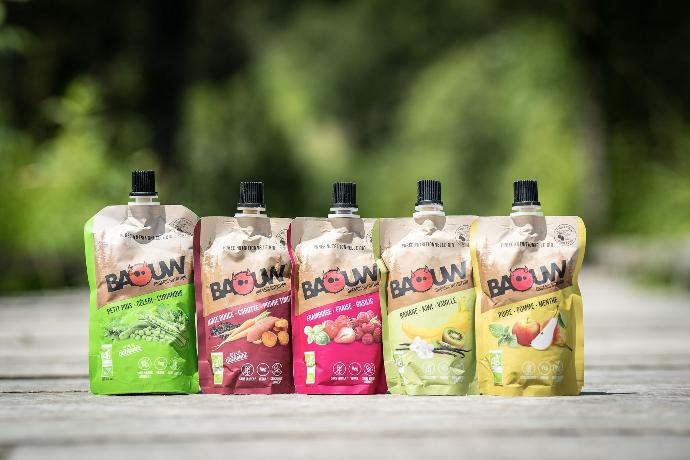
The 'sugar' in your Baouw, for example, is all fructose, which comes naturally from the fruit we've chosen for our bars and purées, with a low or moderate glycaemic index.
Honey (beware of preconceived ideas!)
Often considered a health food, it can be if consumed in very small quantities and especially with honeys that have a low glycaemic index: chestnut honey and certain types of acacia honey (depending on the type of harvest, etc.). ‘It should be consumed in moderation, however, as it is still pure sugar,’ warns our nutrition expert. ‘And I'm not even talking about fake honeys, which are all too common on the shelves these days. Or industrialised honeys and coloured sugar syrups.’
Complex carbohydrates (cereals, starches, pasta, potatoes, rice, etc.)
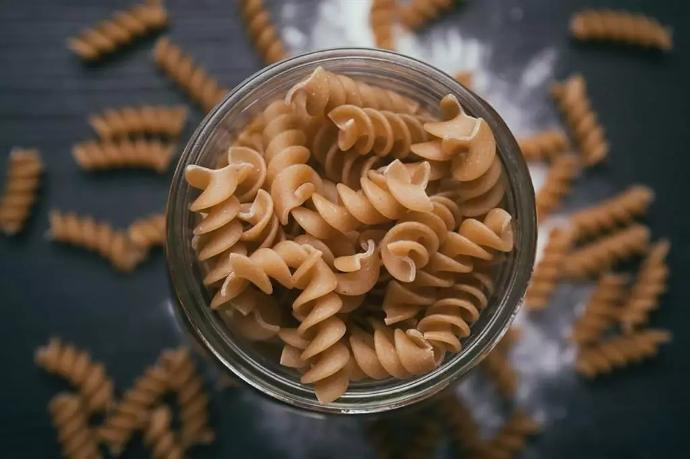
‘For a long time they were called ‘slow sugars’. Over the last thirty years or so, we've realised that these so-called slow sugars can be just as harmful as honey or table sugar, for example. Generally, we lump everything together: the bowl of cereals, the morning sandwich, with the sweet potato, the lentils... But these foods have nothing to do with each other! While sweet potatoes are a health food par excellence, bowls of cereals are a disaster. Cereals (and even more refined cereals) have a high to very high glycaemic load’, explains our nutritionist. ‘So there are times when complex carbohydrates can be interesting: when you need to replenish your carbohydrate intake, after a heavy sports session, for example. In this case, choose a carbohydrate with a high glycaemic index, such as potatoes, to encourage a glycaemic peak and therefore the desired insulin secretion. For dinners on a ‘normal’ day, you should still eat starchy foods, but choose those with a moderate glycaemic index: lentils, sweet potatoes, brown rice, gluten-free pasta made from brown rice, buckwheat, quinoa...’.
A soft drink, a slice of pizza and we're already well over the 8 sugars we shouldn't exceed in a day... That's a lot! ‘An 8-year-old child has already eaten more sugar than his grandfather did in a lifetime,’ studies show.
Mono and disaccharides
These are what the food industry has chosen to call sugar. Under this name, we find the ‘good sugars’ (such as the fructose contained in fruit, naturally, called ‘no added sugar’) and the ‘bad sugars’: glucose, saccharose, maltose, etc.
It's important to distinguish the origin of sugars on a label. If you see ‘sugar’ written on the label because it contains fruit, you're on! Don't worry. If you see ‘sugar’ written: fructose syrup, glucose syrup or any other processed product, run!
Glucose and sucrose
Glucose: this is the basic sugar molecule. It is not found in nature. It is therefore a manufactured sugar. Artificially by industry or by the body (produced by digestion).
Sucrose: this is table sugar (= glucose + fructose in equal parts).
‘This sugar is to be avoided!’ warns our nutrition expert.

Do you or don't you need sugar during exercise?
Xavier Thevenard (three-time winner of the Ultra Trail du Mont-Blanc®). ‘We're going to continue to look for moderate glycaemic indexes to avoid the severe backlash that could undermine the whole management of the effort. We're going to turn to NATURAL fructose (fruit sugars) and not products with fructose syrups, to respect our overall health and our liver in particular (to avoid the fatty liver effect...). There has been a veritable explosion in cases of non-alcoholic liver cirrhosis due to over-consumption of products containing synthetic fructose. ‘Yes, your body needs carbohydrates! But quality carbohydrates, and real natural foods, so no added sugars. There's already so much hidden sugar, just about everywhere, in our modern diet. The entire range of Baouw bars (both the fruity ones and those with vegetables and Guérande salt) and Baouw pureeshave no added sugar.
To remember / sugar memo
- A baguette = 50 lumps of table sugar
- A bowl of cornflakes = 10 lumps of table sugar for cereals and the equivalent of 5 lumps of sugar for milk (in terms of insulin secretion).
By Myriam CornuPhoto sport : Benjamin_Becker / Baouw